
Blackjack Basic Strategy: Cut the House Edge to 0.5%
Learn how blackjack basic strategy works, how to read the chart, and how to cut the house edge down to just 0.5%. Start playing smarter today.
Blackjack Basic Strategy Explained: The Chart That Cuts the House Edge to 0.5%
Most casino games don't give you a way to fight back. Blackjack does. With the right strategy, you can shrink the house edge to as low as 0.5%, which makes it one of the best bets on the entire floor.
The key is a tool called the basic strategy chart, and once you understand how to use it, you'll never look at the game the same way again.
Key Takeaways
- Basic strategy is a mathematically proven set of decisions that minimises the house edge in blackjack
- Following the chart correctly can reduce the house edge to approximately 0.5%
- Decisions are based on your hand total and the dealer's visible upcard
- Soft hands, hard hands, and pairs are all handled differently in the chart
- Consistent use of the basic strategy is the foundation of every more advanced blackjack technique
What Is Blackjack Basic Strategy?
Basic strategy is a decision-making system built on the mathematics of probability. It tells you the statistically best move in every possible blackjack situation: whether to hit, stand, double down, split, or surrender.
It doesn't guarantee you'll win every hand. What it does is ensure you never make a decision that costs you money unnecessarily. Over thousands of hands, the difference between guessing and using basic strategy is enormous.
The chart was first developed in the 1950s by a group of US Army mathematicians, and later refined by academics and professional players. It's been tested, re-tested, and verified across millions of simulated hands. There's no debate about whether it works.
If you're entirely new to the game and want to cover the absolute fundamentals first, our Beating the Dealer: Blackjack 101 guide is a solid place to start before diving into strategy.
How to Read the Basic Strategy Chart
The chart looks like a grid. Your hand total runs down the left side. The dealer's upcard, the one card the dealer has face up, runs across the top.
Find where your row and column meet, and that square tells you your move.
Here's what the abbreviations mean:
- H — Hit
- S — Stand
- D — Double down (hit if not allowed)
- P — Split the pair
- Sp — Surrender (hit if not allowed)
That's it. The chart does the thinking for you. Your only job is to look it up and follow it.

Hard Hands vs Soft Hands vs Pairs
This is where a lot of players go wrong. The chart has three separate sections, and using the wrong one is a costly mistake.
Hard hands are any hand without an ace, or a hand where the ace can only count as one without busting. Example: 10 + 7 = hard 17.
Soft hands contain an ace that can still count as 11. Example: ace + 6 = soft 17. This hand plays very differently from hard 17. Soft 17 can actually be doubled in many situations because you can't bust with the next card.
Pairs are two cards of the same value. These have their own chart section because splitting is an option that changes the entire structure of the hand.
Getting these categories confused is one of the most common (and most expensive) mistakes at the blackjack table.
Key Basic Strategy Rules at a Glance
These rules apply to the standard multi-deck blackjack game, which is the most common format you'll find:
- Always split aces and eights
- Never split tens or fives
- Always stand on a hard 17 or higher
- Always hit hard 8 or less
- Double down on 11 almost always (unless dealer shows an ace)
- Stand on soft 18 against a dealer 2 through 8; hit against 9, 10, or ace
- Never take insurance: it's a losing bet over time
That last point is worth repeating. Insurance feels like protection. Statistically, it increases the house edge and costs you money in the long run.
Basic Strategy by Situation: A Simplified Chart
Your Hand | Dealer Shows 2–6 | Dealer Shows 7–Ace |
| Hard 8 or less | Hit | Hit |
| Hard 9 | Double down | Hit |
| Hard 10–11 | Double down | Double (except vs Ace) |
| Hard 12–16 | Stand | Hit |
| Hard 17+ | Stand | Stand |
| Soft 13–17 | Double down | Hit |
| Soft 18 | Stand/Double | Hit (vs 9, 10, Ace) |
| Soft 19+ | Stand | Stand |
| Pair of Aces | Always split | Always split |
| Pair of 8s | Always split | Always split |
| Pair of 10s | Never split | Never split |
Note: This is a simplified reference guide. Full basic strategy charts vary slightly depending on the number of decks and specific table rules. Always check the rules of the game you're playing.
Why the House Still Has an Edge (Even With Perfect Strategy)
Here's the uncomfortable truth that a lot of strategy guides won't tell you directly: even with flawless basic strategy, the casino still has an edge. It's small (roughly 0.5% in favourable rule conditions), but it exists.
The house edge comes from one simple mechanic: the player acts first. If you bust, you lose. Doesn't matter what the dealer does after that.
Basic strategy minimises this disadvantage. It doesn't eliminate it. Anyone promising you a system that beats the house over the long term without card counting or advantage play is not being straight with you.
What basic strategy does is put you in the best possible position on every hand. That's genuinely valuable, especially compared to the 2–4% edge the house holds against players who rely on gut instinct.
Common Mistakes Players Make (And Why They're Costly)
Most players don't realise how much money they leave on the table through avoidable decisions. A few patterns come up again and again:
Standing on soft 18 against a dealer 9, 10, or ace. It feels safe. It isn't. The maths say to hit.
Not doubling down on 11. Players are afraid to put more money in. But 11 is one of the strongest doubling situations in the game. If you want to go deeper on exactly when and how to double, the blackjack double down strategy guide breaks it down in detail.
Splitting tens. A pair of tens is 20. Stand and take the near-certain win. Splitting is almost always a losing play.
Mimicking the dealer. Some players think copying the dealer's strategy (hit until 17, then stand) is smart. It's not: it ignores doubling and splitting opportunities that reduce the house edge.
Playing hunches on "due" cards. Blackjack has no memory. The previous hand doesn't affect the next one. Every decision should be based on current cards, not patterns from a few hands ago.
Does the Number of Decks Change the Strategy?
Yes, but not as dramatically as people think.
The core decisions stay largely the same, but there are subtle differences. Fewer decks slightly favour the player; more decks slightly favour the house. Most games you'll encounter online use six to eight decks.
A few strategy adjustments for single-deck games include doubling on soft 19 in certain situations and splitting differently on some pairs. These are edge-case refinements. For most players, a standard multi-deck basic strategy chart covers the vast majority of decisions accurately.
If you're playing one of Gamdom's blackjack tables, check the number of decks before you start. It matters which version of the chart you reference.
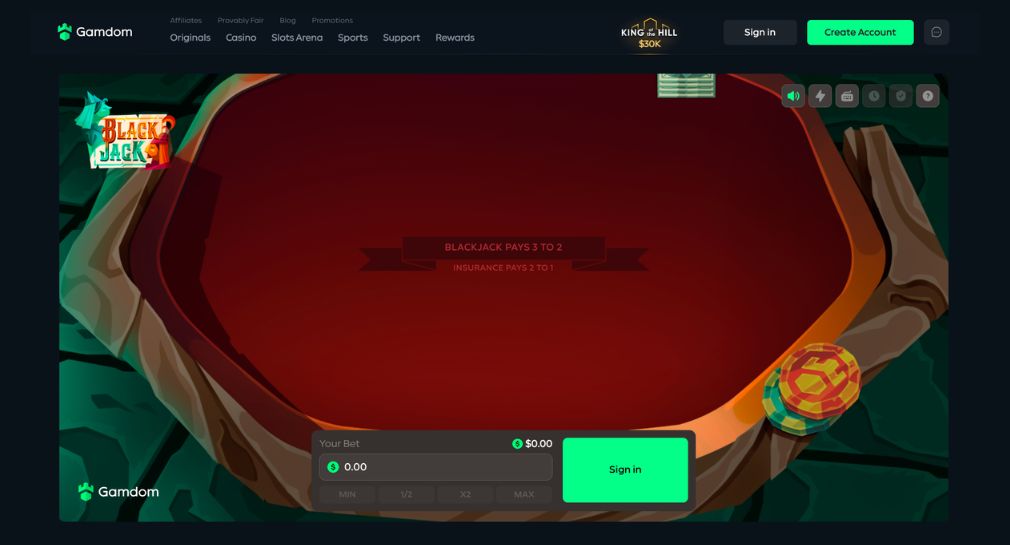
Table Rules That Affect the House Edge
Not all blackjack games are created equal. The rules at the table have a significant effect on that 0.5% figure. Here's what to look for:
Rule Condition | Effect on House Edge |
| Dealer stands on soft 17 | Favours the player (~0.2% better) |
| Dealer hits on soft 17 | Increases house edge |
| Blackjack pays 3:2 | Standard, player-friendly |
| Blackjack pays 6:5 | Significantly increases the house edge |
| Double after split allowed | Favours the player |
| Re-splitting aces allowed | Slight player advantage |
| Surrender available | Favours the player |
The biggest one to watch for: games paying 6:5 on blackjack instead of 3:2. This single rule change nearly doubles the house edge. Walk away from those tables.
Beyond the base game, some variants also offer side bets: extra wagers with their own payouts and odds. They can be tempting, but they need their own strategic thinking. Our guide to blackjack side bets covers when they're worth considering and when they're best left alone.
How to Effortlessly Memorise the Chart
Trying to memorise the entire chart in one session is a fast route to frustration. Here's a smarter approach:
Start with the easy rules: the ones that almost never change. Always split aces and eights. Always stand on a hard 17 or above. Never split tens.
Then focus on the dealer's upcard patterns. When the dealer shows a "bust card" (2 through 6), they're more likely to go over 21. Your strategy shifts: stand more, double more, let the dealer self-destruct.
When the dealer shows a strong upcard (7 through ace), they're more likely to make a hand. Be more aggressive: hit more, try to build a strong total.
Practice with free play first. Many online platforms let you play without real money. Use that time to drill the chart, not to prove you can beat the game without it.
And if you're in the mood to mix things up between sessions, Gamdom has a full range of top table games to try, from baccarat to poker variants, that are worth exploring once your blackjack fundamentals are solid.
Image courtesy of Shutterstock
Practise Basic Strategy on Gamdom's Blackjack
If you want to put a basic strategy to work straight away, Gamdom's own Blackjack game is a clean, no-distraction place to do it. You can find it at gamdom.com/blackjack.
It's a straightforward implementation of the game: no unnecessary side bets cluttering your decision-making, no flashy gimmicks pulling your focus. That makes it a good environment for drilling the chart, especially if you're still building confidence in your reads on soft hands and pairs.
Because it's a Gamdom Original, you're also playing on a platform that's built and maintained in-house, so the rules are clearly stated and consistent. Before your first hand, check the deck count and the soft 17 rule: both affect which version of the basic strategy chart applies, as covered above.
If you're transitioning from reading about strategy to actually using it, this is a practical place to start.
The Chart Is Only Half the Battle
Blackjack basic strategy gives you a real edge over gut-instinct play. But it's worth stepping back and keeping the bigger picture in mind.
Set a session budget before you start and stick to it: not as a vague intention, but as a hard rule. Once it's gone, you're done for the night. Never chase a loss by raising your bets out of frustration. That's when the house edge stops at 0.5% and becomes much, much worse.
The best blackjack sessions are the ones where you stay disciplined. Flat betting while playing a correct strategy gives you the best chance of walking away ahead. Big swings feel exciting in the moment; they tend to look different in hindsight.
If you ever feel like gambling is no longer fun, or that you're playing to recover money rather than for entertainment, take that seriously. Gamdom's responsible gambling tools include deposit limits, session reminders, and self-exclusion options. Use them proactively, not as a last resort.
Blackjack is one of the most skill-friendly games you'll find in any casino. With a basic strategy in your corner and a clear head at the table, you're giving yourself the best shot possible. That's really all you can ask for.


