
No KYC Crypto Casinos: Guide to Anonymous Gaming
Anonymous crypto gambling is growing fast. Learn what no KYC implies, which risks players overlook, and how to gamble without exposing your private data.
No KYC Crypto Casinos: Complete Guide
KYC stands for know-your-customer, which is a set of requirements players need to fulfil to get their online casino account verified. Likewise, No-KYC means that no such thing is required.
Key Takeaways:
- KYC requirements are often there just to satisfy regulators (but they serve their purpose)
- “No KYC” doesn’t always mean zero verification; fine print matters a lot.
- Anonymous gambling shifts responsibility from the online casino to the player.
Online casino gambling has changed dramatically over the years. It started out as a relatively open space with limited rules and regulations. In the early days of the internet, players had the luxury to gamble whenever and wherever they wanted.
Fast-forward to 2026, and the industry is much more heavily regulated, document-heavy, and, for many players, invasive.
Today, most licensed online casinos will ask for your passport, a utility bill, a selfie, and sometimes even proof of where your money came from. And you’ve got to provide all that before you see a single withdrawal.
That's KYC in a nutshell. Unsurprisingly, not everyone is comfortable with it.
Crypto casinos changed the equation. For the first time, players could deposit, wager, and withdraw without handing over sensitive personal data.
A new category of casino emerged to serve that demand: no KYC crypto casinos.
But what does "no KYC" actually mean? Is it legal? Is it safe? This guide answers all of that, without sugarcoating the risks. So, keep reading!
What is the Know-Your-Customer (KYC) Requirement?
KYC is a mandatory identity verification process that regulated gambling operators are legally required to follow.
In practice, it means submitting one (or all) of the following documents:
· A government-issued photo ID (e.g., passport or driving licence)
· Proof of address (utility bill, bank statement)
· A selfie, sometimes holding your ID
· Source of funds documentation (usually required only for large amounts)
None of that is arbitrary. These requirements exist for real reasons, as we’ll elaborate in the next section.
The Purpose of KYC in Online Gambling & Sports Betting
The gambling industry is a high-risk sector for financial crime. The thing is that there’s a lot of money involved. Plus, money can travel from one part of the world to another without any major obstacles.
From the regulators’ point of view, that’s a cause of concern. The solution they’ve come up with is pretty straightforward: KYC.
You can think of it as the industry's answer to a couple of serious regulatory concerns:
Anti-money laundering (AML)
There have been many cases of criminals using gambling to “launder” dirty money. In the past, they frequently used the “chip walking”, which involved depositing money, playing minimally, and withdrawing cash as legitimate winnings. KYC makes this significantly harder.
Counter-terrorism financing (CTF)
Regulators require operators to ensure funds aren't connected to sanctioned individuals or organisations. With KYC verification, it’s relatively easy to check where the money is coming from.
Fraud prevention
Verifying identity makes it almost impossible for fraudsters to spin up multiple accounts to rinse bonuses and distort promotions.
Underage gambling
KYC acts as a hard barrier against underage gambling. The operators will see how old you actually are. They will deny you access to the site if you’re not 21 (or 18 in some jurisdictions).
The reasons for implementing KYC may sound noble on the surface, but there’s another layer to it. In many jurisdictions, it isn’t optional.
In fact, KYC is often a core requirement imposed by regulators before an online casino or sportsbook can obtain – or keep – its operating licence.
Who Controls KYC Casinos?
The strictest KYC requirements don’t come from operators. Instead, they come from regulators. And the tougher the licensor, the more thorough the KYC process is.
That said, here are some of the regulatory bodies widely considered top-tier:
UK Gambling Commission (UKGC)
It’s one of the most rigorous licensors in the world. If an online casino carries this license, it’s almost 100% certain that you can trust that operator.
Malta Gaming Authority (MGA)
This is the gold standard within the EU. You can think of it as the continental answer to the UKGC license.
Anjouan Gaming Authority (Comoros)
To obtain and/or renew this licence, operators must implement strict KYC policies. On top of that, full compliance with international Anti-Money Laundering (AML) regulations is mandatory.
Curaçao Gaming Control Board
It’s common among offshore operators. Rules and regulations are a bit more lenient, but KYC is encouraged.
Generally speaking, if an online casino/sportsbook holds any of these licenses, it’s likely that it has KYC requirements. In simple English, you will have to verify your account at some point (assuming you actually wish to gamble for real money).
What Does “No KYC” Actually Mean?
Here’s where it gets more nuanced than most guides will tell you. “No KYC” isn't really one thing. It’s more of a spectrum.
The term itself can refer to any of the following:
No KYC at All
You can sign up with just an email address, a phone number, or via your Google/Stream/Telegram account.
There are even some crypto casinos where you can just send over some BTCs (that is, Satoshis) and start gambling ASAP once they arrive. Basically, account creation isn’t required.
If you win, you can simply send the money back to your crypto wallet, with no questions asked.
Sounds awesome, right? Well, yes and no. While anonymity is practically 100% guaranteed, you don’t have much protection in case of fraud. After all, there’s limited evidence that you gambled on that platform.
No KYC at Registration
You can register an account by providing limited information about yourself. An email address would suffice.
But no KYC at the start of your journey doesn’t mean it doesn’t exist at all. You might be asked to provide proof of identity later on.
In most cases, the KYC requirements come into play when it’s time to withdraw money. You gamble freely, but once you try to cash out, verification kicks in.
With many online casinos, the requirement doesn’t become active until you’ve reached a certain payout threshold. For instance, you may be able to withdraw $50 or $100 with no questions asked, but if you want to go with a couple of thousand, you will have to verify your account.
What “No KYC” Doesn’t Mean?
KYC doesn’t mean that it’s guaranteed that the casino won’t ask for documents in any circumstance. If something looks suspicious, they will act.
For example, if your account triggers the operator’s fraud detection system, they might ask you to do the KYC. Otherwise, they might block or close your account.
But it’s not just about protecting themselves from bonus abuse and other scams. It’s also about learning about their customers. This goes especially if you’re betting (and winning) a lot of money.
Traditional Online Casinos vs. No-KYC Verification Casinos
| Feature | KYC Online Casinos | No-KYC Casinos |
| Registration | Email + ID Documents | Email and/or Crypto Wallet |
| Data Collected | ID, proof of address, financial documents, etc. | Minimal or None |
| Regulatory Oversight | High | Low (or even Nonexistent) |
| Withdrawal Speed | Sometimes Delayed by Verification | Often Instant |
| Dispute Resolution | Comprehensive | Limited |
| Data Breach Risk | Higher | Lower |
| Fund Seizure Risk | Lower | Higher |
Neither column is automatically better. It depends entirely on what you value.
That said, no-KYC casinos have gained serious traction lately – especially with the rise of blockchain technology. Why is that the case?
Why Some Bitcoin Casino Sites Don't Require KYC
The existence of no-KYC crypto casinos isn't accidental. It's the result of three specific factors converging: jurisdictional flexibility, the technical architecture of cryptocurrency, and genuine market demand.
Most no-KYC crypto casinos operate in jurisdictions that don’t emphasise identity checks. Those requirements are typically lighter and/or inconsistently enforced.
The real shift, however, is technical. Traditional casinos operate on bank transfers, cards, and payment processors. Every one of those intermediaries requires identity verification, which makes KYC unavoidable.
Crypto changes that. Wallet-to-wallet transfers on Bitcoin or Litecoin don’t require a verified name. Addresses are pseudonymous by design. The infrastructure simply doesn’t demand identity the way fiat systems do.
There’s also real demand. Some players value privacy. Others live in restrictive jurisdictions. Some don’t want passport scans sitting in another database after multiple industry data breaches. For many, it’s about discretion, not secrecy.
That said, no KYC doesn’t automatically mean no controls. Many crypto casinos still run internal risk checks and on-chain monitoring.
Usually, it means different standards rather than no standards at all.
Privacy Benefits of No KYC Online Casinos
This is where no-KYC crypto casinos make their strongest case. The privacy advantages are real, concrete, and relevant to a significant portion of the gambling population. One of the key benefits of such gambling platforms is limited data exposure.
Reduced Data Exposure
When you register at KYC casinos, you hand over some of the most sensitive documents you own. What we’re talking about are government ID, proof of address, and facial biometrics in some cases.
Plus, you might also be required to provide source-of-funds information that maps your financial life.
All of that is stored in databases managed by companies whose security practices you cannot audit.
Gambling platforms have been on the receiving end of significant data breaches over the years. Customer records, identity documents, and payment data have been exposed.
For players at anonymous crypto casinos, the exposure surface is dramatically smaller. If there’s no passport on file, there’s no passport to leak.
Fast Payouts
One of the most practical complaints about KYC casinos is withdrawal delay. Document submission queues, compliance review periods, manual verification steps, and more – it all takes time.
That’s why it’s not unusual for a withdrawal to take days when the process hits a snag.
No-KYC crypto casinos process payouts at blockchain speed. For most crypto transactions, that means minutes. The friction that compliance introduces is simply absent.
Financial Privacy
At KYC casinos connected to traditional payment methods, gambling activity can appear on bank statements, flag in financial reviews, and create a paper trail that extends well beyond the casino itself.
At anonymous crypto casinos, there's no bank statement involvement, no gambling category flag, and no shared financial data flowing to third-party processors.
This matters particularly in countries where there's significant social stigma around gambling. Further, there are many professions where financial histories may be reviewed as part of licensing or employment.
There doesn’t even have to be any particular reason, actually. It matters to anyone who simply prefers that their leisure spending remains their own business.
Global Accessibility
No-KYC crypto casinos are accessible from more places. Because they don’t tie accounts to verified identities or strict geographic banking checks. The result is that they can onboard players that mainstream KYC casinos simply exclude.
Borderless crypto payments make the model genuinely global in a way that fiat-based platforms never fully achieved. That said, one thing needs to be crystal clear: accessibility does not override local law.
Even if an anonymous Bitcoin casino allows you to register and deposit, you’re still subject to the gambling regulations in your own jurisdiction. The platform’s structure doesn’t cancel your legal responsibility.
Legal Implications of Anonymous Crypto Gambling
Online privacy is awesome, but only when it sits inside a legal framework.
No-KYC crypto casinos can reduce the amount of personal data you hand over. That’s a structural advantage, but it doesn’t remove you from the legal environment of your own country.
Players who treat no-KYC platforms as an escape hatch from gambling laws misunderstand both the tech and the regulation behind it.
Your physical location still matters. Local restrictions still apply. Tax obligations don’t disappear. Enforcement doesn’t vanish.
So, remember that privacy protects your data, but it doesn’t cancel your responsibility.
Privacy is about data exposure. Legality is about compliance with the law. Confusing the two is where most mistakes start.
Are Anonymous Crypto Casinos Illegal?
It depends entirely on jurisdiction, and the distinction between operator regulation and player regulation matters here.
Many countries prohibit unlicensed operators from offering gambling services to their citizens. However, they tend not to specifically criminalise the act of a player accessing those services.
Others, however, do punish it. The spectrum is wide, and it shifts regularly as governments update their approaches to online gambling and cryptocurrency.
Players are responsible for understanding the gambling laws in their own country. That's not a disclaimer to brush past. Instead, it's a genuine practical reality.
Anonymous bitcoin casinos operating from Curaçao aren’t insulated from the legal obligations of the player sitting in a jurisdiction that restricts online gambling.
Tax Considerations
Online casino winnings don’t become invisible just because they sit in a crypto wallet.
Tax treatment varies by country, but the underlying principle is consistent: switching from fiat to crypto doesn’t automatically remove reporting obligations.
The asset type changes, but the legal responsibility doesn’t. That said, here are the core points to keep in mind:
- Gambling winnings may be taxable as income
- Crypto gains on top of winnings may trigger capital gains tax
The specifics vary enormously depending on the country. If you're winning significant amounts, speak to a tax professional in your jurisdiction. Don't assume anonymous means untaxable.
Risks of Anonymous Crypto Casinos
Credibility requires honest coverage of the downside. No-KYC crypto casinos and anonymous crypto casinos carry specific risks that don't apply (or apply less severely) to regulated KYC casinos.
Fund Seizure Risk
The irony of some no-KYC crypto casino models is that the very absence of verification can lead to funds being frozen.
If an operator suspects bonus abuse, multi-accounting, or unusual activity, they may suddenly request documents they claimed they didn't need.
Players who assumed the "no KYC" promise was unconditional find their withdrawals blocked pending verification they weren’t prepared for. Always read withdrawal terms in full before depositing.
Regulatory Issues
No-KYC crypto casinos operating under offshore licences carry a different layer of risk. That risk sits with the operator. However, it can hit players directly.
Licences can be challenged, and regulators can intervene. Platforms can be suspended without long notice. In more serious cases, funds held by the operator can become temporarily inaccessible during investigations.
This is not speculation. It has happened before at offshore crypto gambling sites. Players have logged in to find withdrawals frozen while disputes were resolved.
That is why operator stability matters.
When you choose where to play, you are not just assessing bonuses and RTP. You are assessing jurisdiction, regulatory strength, and operational durability. Ignore that, and you are taking on more risk than you realise.
Scam Operators
Lower regulatory barriers mean lower barriers to entry. This applies to everyone, including bad actors.
A rogue platform can spin up, collect deposits, and disappear without the accountability that comes with a major gambling licence.
How do you check? Look at the following:
- Domain history – how long has the site existed?
- Community reviews – what are players saying on forums like Reddit and Trustpilot?
- On-chain payment transparency – can you verify the wallet addresses?
- Ownership transparency – is there a named company behind the casino?
Problem Gambling Concerns
Regulated KYC casinos are required to implement responsible gambling tools: deposit limits, loss limits, session timers, self-exclusion systems, and so on.
These exist because the evidence base for their effectiveness in protecting vulnerable players is strong.
No-KYC crypto casinos and anonymous crypto casinos are not subject to the same requirements. Some implement voluntary protection. Many don't.
Players who rely on these tools as part of managing their gambling should factor this into any decision.
Finding the Best No KYC Casinos
Not all no KYC casinos are created equal. Some genuinely prioritise user privacy while maintaining professional standards.
Others simply use “anonymous” as a marketing hook. If you’re choosing to play without identity verification, the margin for error is smaller. What this means is that your due diligence needs to be sharper.
Here’s how to separate serious operators from risky platforms.
Reputation & Reviews
In the no KYC space, reputation is everything. Without strong regulatory oversight, community trust becomes the main filter. Look for:
- Consistent payout confirmations
- Real player feedback on withdrawals
- Longevity of the platform
- Active communication from the team
A casino operating for several years with steady crypto payouts carries significantly less risk than a brand-new platform promising “instant anonymous riches.”
Pay attention to patterns. Occasional complaints are normal. Repeated reports of frozen accounts are not.
Deposits and Withdrawals
This is where no KYC casinos differentiate themselves. Most accept major cryptocurrencies such as Bitcoin and Ethereum, often alongside stablecoins like Tether.
The three most important questions are:
- Is KYC triggered above certain thresholds?
- Are there withdrawal limits?
- How long do payouts actually take?
Some platforms advertise “no verification,” but quietly reserve the right to request documents for large withdrawals. Knowing this before you deposit avoids unpleasant surprises later.
Also check network fees, minimum withdrawal amounts, and processing transparency. Serious crypto casinos publish clear policies instead of hiding behind vague language.
Game Library – Slots, Live Dealer Games, and More
Privacy should never mean sacrificing quality. The best no KYC casinos partner with recognised game providers and offer a full portfolio: slots, live dealer tables, crash games, provably fair originals, and more.
But it’s not just about quantity; it’s also about the quality of games. They need to come with verified RTP information, reliable software, and nig money-making potential (high RTP + decent max. win).
Is Gamdom a No Verification Online Casino?
Short answer: yes, under normal conditions.
KYC is not mandatory for deposits, gameplay, or standard withdrawals. However, it may only be requested in certain cases. Due to AML laws, you may be asked to provide documents verifying your identity and the source of your funds.
Those “certain cases” likely include:
- Large withdrawal amounts
- Rapid deposit-and-withdrawal cycles
- Behaviour that triggers AML monitoring systems
- Suspicious or irregular account activity
In other words, Gamdom operates as a no-KYC crypto casino for everyday use but reserves the right to verify accounts if compliance flags are triggered.
This hybrid model is common among crypto gambling sites as it takes the best from both worlds. It allows privacy-focused users to play without uploading documents, while still keeping AML safeguards in place for regulatory protection.
How to Verify Your Gamdom Account (If You Want To)
The platform includes a “Level 1 Verification” section inside the account dashboard, but it is presented as optional rather than required.
If you prefer to complete Level 1 verification proactively, the process is straightforward. Here’s how to do it:
- Log in to your Gamdom account and go to Settings
Select the “Complete level” tab under Verification
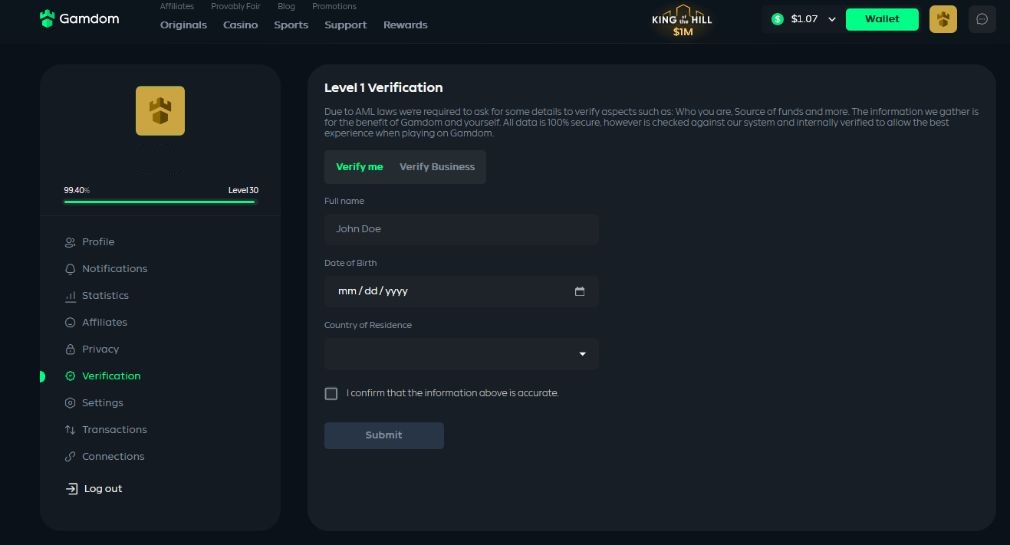
- Fill in your full name, date of birth, and country of residence
- Check the box to confirm the information is accurate
- Hit “Submit” and wait for approval
The whole thing takes less than a minute. There is no document upload at Level 1; only basic personal details are required.
KYC or No KYC – You Decide
In simple terms, KYC exists to protect players, but also to satisfy regulators, operators, and the financial system. No-KYC models exist to protect player privacy.
KYC casinos provide formal oversight, dispute resolution, and regulatory accountability. On the contrary, fully anonymous platforms prioritise speed, access, and minimal friction, but with fewer safety nets if something goes wrong.
Neither is automatically superior. The best option? A privacy-conscious crypto casino that has a KYC policy in place, but applies it only when necessary.
Crypto gambling sites like Gamdom require no KYC at sign-up. Nor for regular play. Not even for small withdrawals.
Only when some red flags are raised.
That structure protects your data by default. At the same time, it preserves regulatory backing when it actually matters.
Ultimately, this comes down to control and responsibility. You want privacy, but you also want operational stability. The smart play is choosing platforms that respect both.
Frequently Asked Questions
Is it legal to use no KYC crypto casino apps?
It depends entirely on your jurisdiction. The mere existence of a no KYC casino does not override local gambling law. Some countries prohibit operators from serving local residents. Others go further and restrict players themselves.
How do crypto casino free spins compare to bonuses at traditional casinos?
Crypto casino bonuses tend to be much more lucrative than those at traditional gambling sites. It’s because most Bitcoin casino sites are relatively new, so they use promos to attract customers.
What happens if a no-KYC casino asks for documents after I've won?
Even casinos marketed as “no KYC” include clauses in their terms that allow verification requests if suspicious activity is detected. If you refuse or fail to verify, funds can be frozen.
Are no KYC casino winnings taxable?
In most jurisdictions, yes. Gambling winnings tend to be taxable regardless of how they were earned or where the casino is based. Crypto adds an additional layer, as gains may also be subject to capital gains tax depending on your country.


