NFL Overtime Rules Explained: Coin Toss, Wins, Ties
Learn all about NFL overtime rules: who gets to possess the ball first, how the coin toss works, and how winners are decided in the overtime period.
NFL Overtime Rules Explained: From How They Decide the Winner to How to Bet on Them
Overtime exists across many sports, but in the National Football League (NFL), it cranks the tension to absurd levels.
The overtime rule in the NFL didn’t come from a rulebook brainstorm. Instead, OTs were introduced due to games that refused to end.
Key Takeaways:
- Overtime rules have evolved significantly since their introduction in 1955.
- The coin toss decides which team will possess the ball on the first drive.
- Scoring a touchdown or a field goal on the first drive no longer means the end of the game.
Over the years, the OT NFL rules evolved, adding even more excitement to the game. Today, overtime is more than just stadium drama; it's also something you can bet on!
But before you dive nose-first into the world of OT betting, it's essential to learn the basics: how many overtime periods are there, how it's decided which team will possess the ball first, and so on.
How Does NFL Overtime Work?
If the score is still tied at the end of the fourth quarter, the teams head into a 10-minute overtime. That's the NFL overtime rule in a nutshell.
The purpose of the overtime period is to determine the winner of the game. Sounds logical, but the NFL didn't always have this rule.
In the league's early days, tied postseason games created chaos: there was no real sense of closure.
Some games were replayed weeks later; others ended in a tie. All this frustrated fans, forcing the NFL to find a solution.
The solution came in the form of sudden-death overtime. The rule was met with euphoria, especially after the 1958 NFL Championship Game.
Known as “The Greatest Game Ever Played”, the matchup saw the Baltimore Colts and New York Giants play the first overtime in NFL history.
The game (and its overtime climax) became a milestone, after which nothing would be the same again.
And there was no turning back: it made the NFL overtime rule a staple of the game.
However, not all the rules used in 1958 remain in effect. The NFL has adjusted its rulebook numerous times since then, making some significant changes along the way.
One of the biggest concerns is the coin toss rule.
The Coin Toss Rule Decides the First Team to Possess the Ball
Before the overtime period starts, it needs to be decided which team will possess the ball first. To keep the decision as random as possible, a coin toss is introduced.
The visiting team's captain is the one who gets to call the toss: heads or tails.
After the referee flips the coin, the winner will pick one of the following three options:
- Possess the ball on the first drive
- Defend on the first drive
- Choose which end of the field to defend
When the basics are decided, it's time for the game to resume action. In the past, the rule was that the team that scored a touchdown was declared the winner.
This gave the team that won the coin toss an advantage, which is why the NFL rulemakers decided to adjust the stipulations.
As a result, OTs aren't strictly sudden death anymore, even though it still does exist.
Who Wins in OT (and How)?
In the past, captains almost always chose to attack first. The reason was that the team that got the ball first could win the game with a touchdown.
However, in today’s NFL, a TD on the first possession isn't the end.
Under the new NFL overtime rules, the game no longer ends automatically after a first-drive TD. The other team is guaranteed a possession to respond.
If that second team scores a touchdown as well, the game continues, and the next score wins. The overtime effectively reverts to the old-style sudden-death format.
If the team that possesses the ball on the opening drive kicks a field goal, the opponent will get a chance to win. For that, they need to score a touchdown.
If they score a field goal, the game will switch to sudden death: the first to score (field goal or TD) wins.
Defense can win games, too. An interception or fumble returned for a touchdown ends things instantly.
Period Structure Under the New Overtime Rules
Regular-season overtime consists of a single 10-minute period, shortened from 15 minutes in 2017 as part of the NFL’s player safety initiatives.
If neither team leads when time expires, the game ends in a tie. This makes American football one of the few sports in which draws can occur even after the overtime period.
In association football, for example, if the score is tied after extra time (football's version of OT), a penalty shootout will decide the winner.
Draws can happen in the NFL’s regular-season games, but not in the playoffs. The National Football League cannot allow ties in postseason play, so multiple overtime periods may be played.
Each period lasts for 15 minutes with 2-minute intermissions between periods. After the fourth overtime period, additional coin tosses are conducted to determine possession for subsequent periods.
Do NFL Teams Get to Call Timeouts?
Each team receives two timeouts during the regular-season overtime period, while playoff games provide three timeouts per OT.
These timeouts do not carry over from regulation and are specific to the overtime period itself.
One unique aspect of NFL overtime is the absence of instant-replay coach's challenges: there are none.
All replay reviews during overtime are initiated by the replay official or the league's centralized replay command center.
The reason the league's officials decided to implement this rule is to prevent teams from using challenges as time-management tools during key OT moments.
Can an NFL Game End in a Tie After OT?
How many overtime periods are possible before the game is declared a tie? The answer depends on whether it's a regular–season game or a postseason matchup.
In the regular season, the maximum number of overtime periods is one. If nobody wins after one 10-minute overtime period, the game ends in a tie. No second OT is allowed.
In all Playoff games (including the Super Bowl), it's a different story.
Unlimited Overtimes in Postseason Games
Postseason overtime periods are unlimited because these games must have a winner.
So, if the score is tied after the first 15-minute overtime period, another one is played. And it can go like that forever.
In theory, NFL Playoff games could last forever, but in reality, they rarely go past the first OT.
Wonder what the record number of overtime periods in the NFL is? Somewhat surprisingly, the answer is: two OTs.
There have been only six double-overtime games ever, namely:
· 1962 AFL Championship: Dallas Texans vs. Houston Oilers
· 1971 Divisional Playoffs: Miami Dolphins vs. Kansas City Chiefs
· 1977 Divisional Playoffs: Oakland Raiders vs. Baltimore Colts
· 1986 Playoffs: Cleveland Browns vs. New York Jets
· 2003 NFC Wild Card: Carolina Panthers vs. St. Louis Rams
· 2012 AFC Divisional: Baltimore Ravens vs. Denver Broncos
In the entire 50+ years of the NFL overtime rule, there has never been a game that saw three OT periods.
NFL Overtime Rules History
The year 1869 is widely regarded as when American football was born. However, that version of the sport differs a lot from the games played in the 2020s.
For example, the first-ever American football game (Rutgers vs. Princeton) was really a mix between association football and rugby.
There were 25 players on each team, and holding opposition players was not allowed. Plus, players wore turbans instead of helmets.
American football has come a long way since, but some rules of the game continue to evolve even in the modern era.
One of those is the NFL overtime rule, which has seen some major changes even in the 21st century.
· Early overtime history: Professional football's relationship with overtime began in the 1940s, but the first time an overtime period was played was in 1955. That's when the Baltimore Colts defeated the New York Giants 23–17 in the first NFL game to use sudden death rules.
· Introduction of regular-season overtime rules in 1974: The OT format gained national prominence, and the rulemakers decided to keep it. However, they did not introduce regular-season overtime rules until 1974.
· Modified sudden death era (2010–2021): Beginning in 2010, playoff games adopted “modified sudden death” rules, where field goals no longer ended the game immediately. The other team received an opportunity to possess the ball as well. TDs on the first possession still resulted in wins.
· No sudden death in the opening drive starting 2022: It was January 2022 when the NFL clubs decided it's best to get rid of the sudden death on the first drive. They changed the rule so that both teams now get to possess the ball in playoff overtime (no matter what happens on the opening drive).
· New regular-season overtime rules take effect in 2025: The NFL decided to align overtime formats throughout the season. As a result, both teams now have the ball in OT in regular-season games.
In simple words, the main NFL overtime rules are pretty much the same in the regular season and postseason. There are still some differences, though.
For example, there is just one 10–minute overtime period in the regular season (instead of unlimited 15–minute ones in the postseason).
Further, as per regular-season overtime rules, games can still end in ties.
NFL Overtime Rules vs. Other Sports
Overtime exists across sports, each playing by its own rules. While some rely on clean, sudden-death rules, others can take ages to complete.
Furthermore, in some sports, overtime periods are frequent. In others, they happen once in a blue moon.
NFL vs. College Football Overtime Rules Comparison
You may think of college football as the NFL’s younger cousin, but its differences go beyond the age rules.
The two American football versions differ in many aspects, including overtime rules, where they have:
· Different starting position: College overtime begins with the team in possession at the opponent's 25–yard line, which makes drives shorter and more predictable. In comparison, the NFL requires a full-field march.
· Different game clock: The NFL uses a 10–minute (regular season) or 15–minute (playoffs) overtime period. In NCAA football, there's no game clock; only a play clock.
· Number of overtime periods: In the NFL, the rule is one OT in the regular season, unlimited in playoffs. With college, it's unlimited OTs in all cases.
· No ties in college football: NFL regular–season games can end in ties because only one OT is allowed. In college, overtime continues until someone wins.
· 2–point conversions: In NCAAF, if a team scores a touchdown in 3rd overtime (or after), they must attempt a 2–point conversion. The reason is to prevent extremely long overtime games.
College OT is essentially a red–zone duel, emphasizing execution over strategy. NFL OT is closer to normal gameplay, where elaborate tactics often matter more than individual talent.
NFL vs. CFL Overtime Rules Comparison
NFL and CFL overtime rules might look similar on paper, but in practice, they lead to very different endings.
In the Canadian version of the game, each team has the ball. Whether the first team scores or not, the second team will get its chance.
The team that scores a touchdown needs to attempt a 2–point conversion afterwards.
What's interesting is that there's no sudden death and no game clock. Instead, the overtime period can go on indefinitely.
There are some similarities, though. For instance, a coin toss still decides which team will possess the ball first.
Overtime Rules in Other Sports
Alternatives to the NFL, such as college football and Canadian football, also use overtime periods, but with a few rule tweaks.
The fundamentals are essentially the same: a coin toss decides which team gets to possess the ball first, and the game doesn't automatically end on the opening drive.
Once you move away from American football, however, overtime starts to look very different.
Other sports follow entirely separate formats, often with rules that diverge significantly, as the table below clearly shows.
| Sport | When Overtime Happens | Overtime Format | Special Notes |
| Association football | In knockout matches, only if the score is tied after 90 minutes | Two 15–minute extra time periods (30 minutes total) | Penalty shootout takes place if no winner after extra time |
| Basketball | If the game is tied after four quarters | 5–minute overtime period; repeated until someone wins | Unlimited overtime periods |
| Baseball | Tied after 9 innings | Extra innings (top+bottom until winner) | “Ghost runner” on 2nd base since 2020 |
| Ice Hockey | Tied after 3 periods | 3-on-3, 5-minute sudden–death OT in regular season and 5–on–5, 20 minutes in playoffs. | Shootout follows if no OT goal |
| Rugby Union | Knockouts only | 2 x 10-minute OT periods; then 10–minute sudden death; then kicking competition | One of the rare sports with a kicking shootout |
| Rugby League | Some knockout games | 2 x 5–minute OT; then Golden Point (sudden death) | NRL's Golden Point is similar to the NFL's sudden death |
| The Ultimate Fighter (TUF) | If the first 2 rounds are scored 1–1 | Sudden victory round (extra round) | This is the only “overtime” in mainstream MMA |
In addition to mainstream sports, overtime rules also apply to various esports games. CS: GO tournaments, for example, have a full overtime system (Max Rounds 3 per side, first to 4 wins OT).
Notable NFL Overtime Games and Their Impact
Over the years, a few high–profile endings exposed flaws in the overtime period system. Some of those rules literally swung seasons in seconds, leaving fans either euphoric or furious.
Those moments, over time, became a real talking point. And many of those games are still remembered today.
1958 Championship: The First Overtime Period in NFL History
The NFL introduced sudden-death overtime in the 1940s, but the first time football saw these rules in action was in 1958.
This happened in the NFL Championship game, which was so impactful that it's still labelled the “Greatest Game Ever Played”.
After 17–17 in regulation, the Baltimore Colts and New York Giants got to play the NFL’s first overtime period ever.
The Giants won the first overtime coin toss in history and decided to possess the ball on the first drive. Unfortunately for them, they went three-and-out straight away.
Then, it was time for the Colts' offense to possess the ball.
Their decision was to put their destiny into the hands of their running back Alan Ameche. Nicknamed the Iron Horse, he then charged into the red zone to score the title-winning TD.
1974 Steelers vs. Broncos: The First Overtime Period in the Regular Season
The Pittsburgh Steelers are one of the NFL's oldest and most successful teams. Their impact on the game is unprecedented, with the Black and Gold taking part in some of the most memorable moments in football history.
One of those is their 1974 game with the Denver Broncos. This was the first regular-season game to see overtime.
Not only that, but the Steelers vs. Broncos game was the first NFL game ever to finish in a tie after overtime.
It was 35–35 after four quarters of regulation, after which the game went to overtime.
After seeing 70 points in regulation, fans expected excitement in overtime, but to their disappointment, neither team scored a single point.
1998 Steelers vs. Lions Thanksgiving Coin Toss Controversy
The infamous 1998 Thanksgiving coin toss still lives in NFL folklore. The Steelers running back Jerome Bettis called “heads,” but referee Phil Luckett heard “tails,” handing the ball to the Lions in overtime.
Detroit chose to possess the ball on the first drive, which proved crucial. The Lions got the ball into the free-kick zone, so their placekicker had no problems scoring three points, leaving the Steelers fuming.
Sure, this wasn't the first overtime coin toss to spark controversy. Still, it certainly played a big part in the NFL’s decision to tweak the overtime rules in the years that followed.
2022: Bills vs. Chiefs: Coin Toss Wins the AFC Divisional for KC
On January 23, 2022, American football fans witnessed one of the most influential overtime periods ever. It happened in the Bills vs. Chiefs AFC Divisional game, which KC won amid some controversy.
After a surreal fourth quarter that produced 25 points in the final two minutes, the Chiefs won the overtime coin toss.
This was the crucial moment of the game as their quarterback, Patrick Mahomes, then led them to a touchdown on the opening drive.
Buffalo's QB Josh Allen, on the other hand, didn't get an opportunity even to possess the ball in the overtime period.
He had been brilliant all night (even producing a go-ahead TD pass with 13 seconds left), yet never got a chance to respond.
2024: The San Francisco 49ers Didn't Know the Overtime Rules in the Super Bowl
The first NFL Championship Game to reach overtime under the new rules was Super Bowl LVIII.
Kansas City defeated San Francisco 25–22, and the overtime period showed the strategic implications of guaranteed possessions.
Luck was on the 49ers' side at first: they won the overtime coin toss and chose to possess the ball first.
But then, they made a decision that basically cost them the title. Instead of pushing for a touchdown, they kicked a field goal on their opening possession.
This gave the Chiefs a clear objective: score a TD to win. And they did precisely that!
The Niners' decision to go for a field goal generated significant post–game analysis. As they later admitted, some of San Francisco's players didn't know the new overtime rules. The Niners apparently thought they were going to win with that 3-point kick.
NFL Overtime Stats You Should Be Aware Of
NFL overtime is supposed to be football's ultimate decider, but the numbers tell a far messier story.
Once a game spills past regulation, the balance shifts in ways most people don't expect. One of the most unexpected facts is that overtime periods are far rarer than they seem.
OTs in the NFL Playoffs Are Extremely Rare
Historically, only about 5–7% of NFL regular-season games end up in overtime.
With 272 regular-season games on the schedule (17 weeks x 16 games), that usually translates to around 14 to 20 OT games per season.
Overtime is even rarer in the postseason, simply because the sample size is much smaller. Looking back at past playoffs, you'll typically find just two or three overtime games per entire postseason.
The Super Bowl is an even bigger outlier. In fact, only two Super Bowls have gone to overtime.
In addition, there was one Championship Game in the pre-Super Bowl era (before 1966) that went into overtime.
| Game | Matchup | Year | Result | Overtime Length |
| NFL Championship Game | Baltimore Colts vs. New York Giants | 1958 | 23–17 (17–17 in regulation) | 8:15 |
| Super Bowl LI | New England Patriots vs. Atlanta Falcons | 2017 | 34–28 (28–28 in regulation) | 03:58 |
| Super Bowl LVIII | Kansas City Chiefs vs. San Francisco 49ers | 2024 | 25–22 (19–19 in regulation) | 14:57 |
NFL Overtime Coin Toss Winning Percentage
Before 2012, overtime could be decided on the very first possession. During that stretch, the team that won the coin toss went on to win nearly two-thirds of the time.
The logic was straightforward: field goals ended the game. If you got to possess the ball first, one decent drive was often all it took.
That dynamic has shifted since the rule change. Coin-toss winners still hold an edge, but it's far smaller. Today, their win rate is just north of 50%, rather than bordering on automatic.
Only 0.2% of NFL Games End in a Tie
Since overtime was introduced in 1974, the NFL has played well over 12,000 games, and only about 30 of them have ended in ties.
That's roughly 0.2% of all games, making ties one of the rarest outcomes in the league.
That said, recent rule tweaks have nudged the odds upward. The combination of a 10-minute overtime limit and revised possession rules has made ties slightly more likely in the regular season.
In fact, fans didn't have to wait long to see a first tie in the 2025 NFL season (the first year with the new overtime rules). It arrived in Week 4, when the Packers-Cowboys game ended in a 40–40 tie.
OT Scoring Is Usually Low
NFL overtime is usually low-scoring. In the regular season, games average around 6 total points, while playoff overtimes creep closer to 8.
That gap reflects a clear shift in tactical approach. Teams tighten up and prioritise field position in order to prevent mistakes that could end their campaign in a single snap.
Can You Bet on NFL Overtime (and Where)?
The short answer: yes, you can!
The longer version is that while most online sportsbooks do offer NFL overtime period betting, the available markets and odds can vary widely.
One site that consistently stands out for both variety and competitive prices is Gamdom.
NFL Overtime Betting Markets
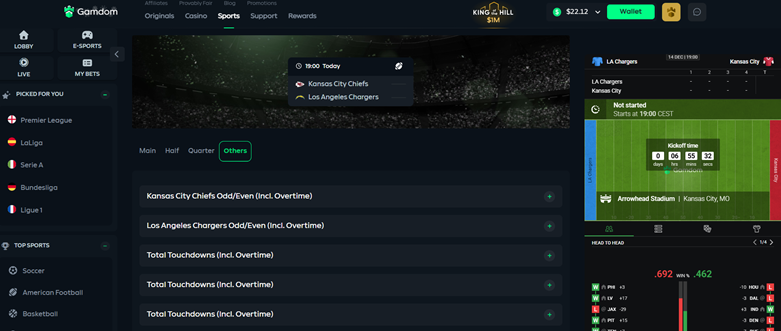
Throughout the NFL season, you can find all sorts of interesting OT betting options at Gamdom, including the following.
The main one is Will There Be Overtime, where you get to bet on Yes or No. Given that OTs are relatively rare, the odds on Yes can be very lucrative, sometimes as high as 10.00.
Apart from markets directly focused on overtime, Gamdom also has some that can be impacted by OTs.
For example, Winner bets include overtime, as well as Total, which combines points from both regulation and overtime.
Other NFL markets where OTs are taken into account include the following:
- Handicap
- Odd/Even
- Total Touchdowns
- Total Field Goals Made
- [Team] Total
- [Team] Odd/Even
- [Player] Passing Yards
- [Player] Pass Completions
- [Player] Passing Touchdowns
- [Player] Carries
- [Player] Rushing Yards
- [Player] Receiving Yards
- [Player] Receptions
- [Player] Touchdowns
All of these markets are available in the pre–game offer, and some of those (Winner, Total, etc.) can be used for live betting as well.
Bet on NFL Overtime at Gamdom Sportsbook!
Feel like betting on overtime? If so, here's how to get started:
- Step 1: Create a Gamdom account
- Step 2: Deposit funds using one of the 50+ available crypto options
- Step 3: Head to the NFL Betting page
- Step 4: Place your bet(s)
Once that's done, all that's left is to watch the game unfold. Cross your fingers and hope the OT gods decide to smile on you.
NFL Overtime Rules: The Final Snap
By now, you know how teams decide whether to take the ball on the opening drive, and why overtime strategy often comes down to fine margins.
You've seen how settling for a field goal versus chasing a touchdown can swing everything. You've also tracked how overtime rules have evolved and where they're likely headed next.
If all that has you hoping for an overtime period in the next NFL game, you're not alone. And if watching isn't enough, you can always put a wager on the OT markets at Gamdom to raise the stakes even further.


